
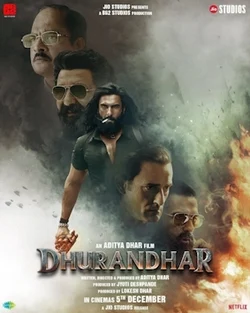

Director: Aditya Dhar
Genre: Political Thriller | National Security Drama
Target Audience: Urban, politically aware viewers
Dhurandhar is a sharply written political thriller that primarily targets an urban, politically aware audience. The film attempts to blend real-world national security events with cinematic storytelling, resulting in an intense narrative that is both ambitious and, at times, conflicted.
One of the film’s biggest strengths lies in its performances—particularly those of Madhavan, Rakesh Bedi, and most notably Akshay Khanna. While actors like Ranveer Singh, Sanjay Dutt, and Arjun Rampal make impactful appearances in fragments, the emotional and narrative weight of the film firmly rests on Akshay Khanna’s shoulders.
Akshay Khanna as Rehman Dakit: The Film’s Core
Akshay Khanna’s portrayal of Rehman Dakit, a character inspired by real-life figures, is the driving force of Dhurandhar. His performance is restrained, layered, and menacing without being overt. With gritty dialogue delivery and moments of sheer intensity, Khanna elevates the material significantly. The film, in essence, revolves around his character’s ideology, decisions, and influence, making his role the undisputed highlight.
Rakesh Bedi complements this with a grounded performance, while Madhavan brings credibility and gravitas whenever he appears on screen.
Story, Politics, and National Security
The film touches upon several important political and national security events from the past 15 years, attempting to draw connections between political decisions and their long-term impact on national security. It goes beyond the commonly discussed narratives surrounding Ajmal Kasab, aiming to explore deeper layers involving handlers, ideologies, and systemic influences.
However, this is where Dhurandhar slightly falters. While the intent is clear, the message is not.
The narrative seems confused between cultural commentary and political critique, leaving the audience uncertain about what director and writer Aditya Dhar truly wants to convey. Is the film a political statement, or is it an exploration of national security failures and challenges? This lack of clarity weakens the film’s ideological impact, despite its strong writing and performances.
Script, Screenplay, and Direction
The script is undeniably brilliant, and the screenplay is exceptionally well-executed. Managing a cast of seasoned actors—each a stalwart in their own right—is no easy task, yet Aditya Dhar handles this complexity with confidence and control. The pacing, scene transitions, and character placements are thoughtfully designed, ensuring the narrative remains engaging throughout.
Technical Excellence and Production Design
Shot entirely in Thailand, the film convincingly recreates locations meant to represent Afghanistan and Pakistan. The attention to detail in production design, set setup, and visual authenticity is commendable. At no point does the film feel geographically unconvincing—a testament to meticulous planning and execution.
Final Verdict
Dhurandhar is a powerful cinematic experience backed by a strong script, excellent performances, and impressive technical finesse. While it struggles to clearly articulate its core message, the film succeeds as a gripping political thriller.
The first half of the applause undoubtedly belongs to Akshay Khanna and Rakesh Bedi, whose performances leave a lasting impact. Despite its narrative ambiguities, Dhurandhar remains a compelling watch—and sets the stage intriguingly for a second part.
Rating: ★★★★☆
Verdict: A must-watch for audiences interested in political thrillers and performance-driven cinema.
Wikipedia – Context & Background
Best for political and historical references.
Wikipedia – Indian National Security Overview
https://en.wikipedia.org/wiki/National_security_of_India
Wikipedia – 26/11 Mumbai Attacks (Contextual Reference)
https://en.wikipedia.org/wiki/2008_Mumbai_attacks